KESSLER: Orbital Incremental Review - Missile Command Meets the Kessler Syndrome
This post may contain affiliate links from places like Amazon and Green Man Gaming, and we may earn a small commission when you click these links. All earnings will go to keeping this website as minimally ad-free as possible.
KESSLER: Orbital Incremental Review - Missile Command Meets the Kessler Syndrome
By Joel | November 10, 2026
➔ Disclosure: This game was purchased. This is an independent review. Not sponsored and not based on a free key. - Joel
Sometimes the best games do not need massive worlds, complicated stories, or hundreds of hours of content. Sometimes all they need is a good idea, a little imagination, and enough explosions to bring back some childhood memories.
There is something immediately familiar about it. At first glance it might remind you of Missile Command, but instead of protecting cities from incoming attacks, you are running an orbital weapon platform, taking aim at the debris floating around Earth and blasting it out of existence.
Think Missile Command meets tower defense, with a little space warfare mixed in. You line up your shots, anticipate the movement of incoming objects, and try to destroy them before they slip past your defenses.
The catch is that you are not just shooting down targets. You are setting off a chain reaction of destruction, and that is where it gets interesting.
Developed by the two person indie team at Periapsis Works, KESSLER takes a simple concept and turns it into an entertaining little space adventure. Sometimes simple is exactly what you want.
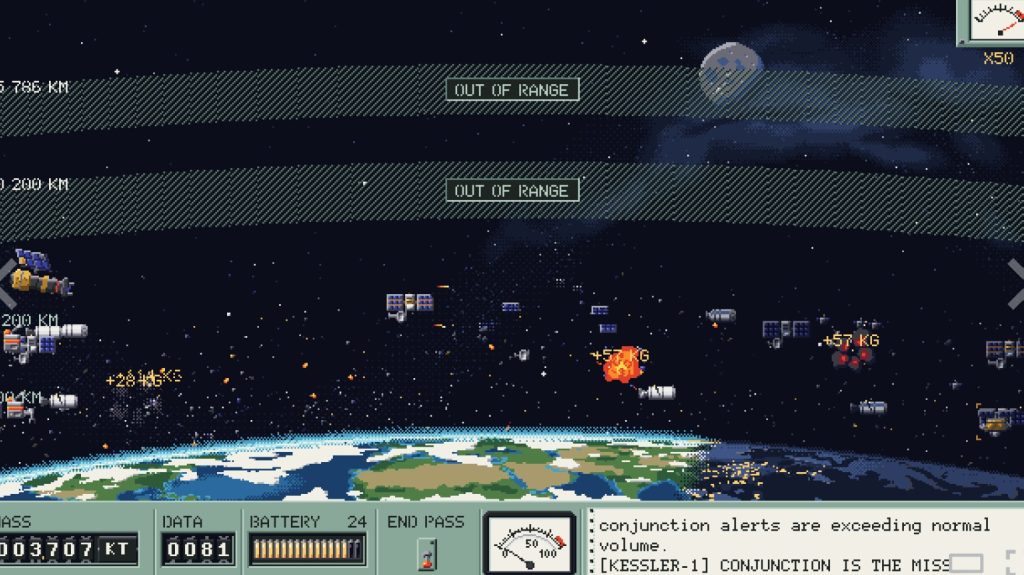
The first thing you notice is the pixel art presentation, and there is a lot of it. It works surprisingly well. Despite leaning hard on pixels, the game does a nice job of keeping the orbital debris distinguishable as it drifts across the screen.
There is plenty of space junk to track, and that is exactly what it looks like: scraps, fragments, and assorted objects floating through the darkness, giving the screen a busy but appealing look. It is not trying to be a graphical showcase and does not need to be.
The presentation fits the gameplay, and there is something genuinely charming about watching a screen full of pixelated debris turn into a fireworks display of explosions.
Missile Command Meets Space Warfare
This is where KESSLER grabbed me. The gameplay has that familiar Missile Command feel, but with a twist: rather than defending Earth from incoming missiles, you control an orbital platform tasked with clearing objects out of orbit.
You line up your shots, judge the timing, and keep your targets from getting past you, and there is a tower defense quality to it as you constantly weigh positioning, timing, and which targets to prioritize.
The real fun, though, comes from the progression. Destroying debris earns credits you pour into better weapons and new abilities, from flak cannons to EMP bursts, and there is a satisfying arc as your modest little defense system grows into a genuinely capable weapon.
The goal is to exploit collateral damage and chain reactions: one well placed shot can trigger a series of collisions, sending debris crashing into other debris in a spectacular domino effect. When a single EMP burst sets off a cascade that clears half the screen for you, it is enormously satisfying.
It is also a clever use of the real world Kessler Syndrome, the phenomenon where collisions between objects in orbit create more debris, which causes more collisions, in a runaway chain. In other words, sometimes the best way to clean up space junk is to make even more of it. Go figure.
Where Things Could Improve
As much as I enjoyed KESSLER, there are places where it could grow. The biggest is length. After roughly four hours I had unlocked everything and seen most of what the game offers, and once you hit that point there is not a lot left to chase.
There is, however, an endless mode to keep playing, but it feels more like a novelty than something that will pull you back to chase high scores or climb a leaderboard.
I would also love more random events to shake things up. Space is an unpredictable place, so why not an occasional meteor shower that threatens your platform, or an unexpected encounter that turns the tables and starts attacking KESSLER itself?
Moments like those would inject some unpredictability, force you to rethink your strategy, and give you a reason to come back after everything is unlocked.
The foundation is strong, and a little more variety would go a long way toward extending the replay value.
Who It Is For
If you grew up on Missile Command, Space Invaders, and Asteroids, or you just like a tight arcade loop with a satisfying upgrade curve, KESSLER is an easy recommendation.
If you need dozens of hours, deep systems, or a reason to grind leaderboards, the four hour runtime may leave you wanting more. Go in expecting a short, polished throwback rather than a long haul, and it delivers.
Final Thoughts: A Little Piece of Childhood
There is something about watching laser fire streak across a screen, followed by a massive explosion, that never gets old.
Ever since I was a kid, the space battles of Star Wars and Battlestar Galactica fascinated me, and KESSLER brought that feeling straight back.
It reminded me of defending cities in Missile Command, shooting down invaders in Space Invaders, and blasting apart rocks in Asteroids, games that did not need elaborate stories or complicated mechanics to capture your imagination. They just needed to be fun.
That is the thing KESSLER quietly reminds you of, the thing that is easy to forget once you start worrying about graphics, performance, and how many hours a game can fill.
We started playing because it was fun, because seeing something blow up on screen was a thrill, because for a little while we could get completely absorbed in whatever was happening in front of us. KESSLER gave me a few hours of exactly that.
So a sincere thank you to the two person team at Periapsis Works. You gave me about four hours, but they were a genuine trip down memory lane, and a game that can make a grown adult feel like a kid again, even briefly, is worth celebrating.
➔ Score:
➔ 4 out of 5
FAQ
What is KESSLER: Orbital Incremental?
KESSLER: Orbital Incremental is a pixel art arcade incremental game from indie developer Periapsis Works. You run an orbital weapon platform, destroy space debris, and use the credits to unlock better weapons and abilities. It plays like Missile Command crossed with tower defense, built around chain reaction destruction inspired by the real Kessler Syndrome.
How long is KESSLER: Orbital Incremental?
About four hours to unlock everything and see most of what the game offers. There is an endless mode for extra play, but the core experience is short and focused rather than a long time sink.
Is KESSLER: Orbital Incremental worth it?
If you love classic arcade games like Missile Command, Asteroids, and Space Invaders and enjoy a satisfying upgrade loop, yes. It is charming, polished, and genuinely fun. Just go in knowing it is short. We scored it 4 out of 5.
What is the Kessler Syndrome?
The Kessler Syndrome is a real phenomenon where collisions between objects in Earth orbit create more debris, which causes more collisions, in a runaway chain. KESSLER turns that idea into its central mechanic, rewarding you for triggering cascading chain reactions among the debris.
Which infantry should you field in Bannerlord? We rank the best foot troops for 2026, led by the Imperial Legionary and the Sturgian Heroic Line Breaker, with each faction's best, the shield wall versus two handed question, and how to use infantry to anchor your army.
Which archers should you field in Bannerlord? We rank the best ranged units for 2026, led by the Battanian Fian Champion, plus Palatine Guards, Sharpshooters and the top horse archers, with how to position archers and what hard counters them.
Our second indie spotlight. Five more games on our radar: a cyberpunk point & click, an emotional stray cat, a brutal precision platformer, a darkly comic zombie auto battler, and an arcade era score chaser. We have not gone hands on yet, but here is why each one caught our eye.
Got questions? Have an article idea you want to pitch? Or do you just want to talk about why City of Heroes is one of the greatest MMOs of all time? Then send us an email! :)